LUNEDI MATTINA
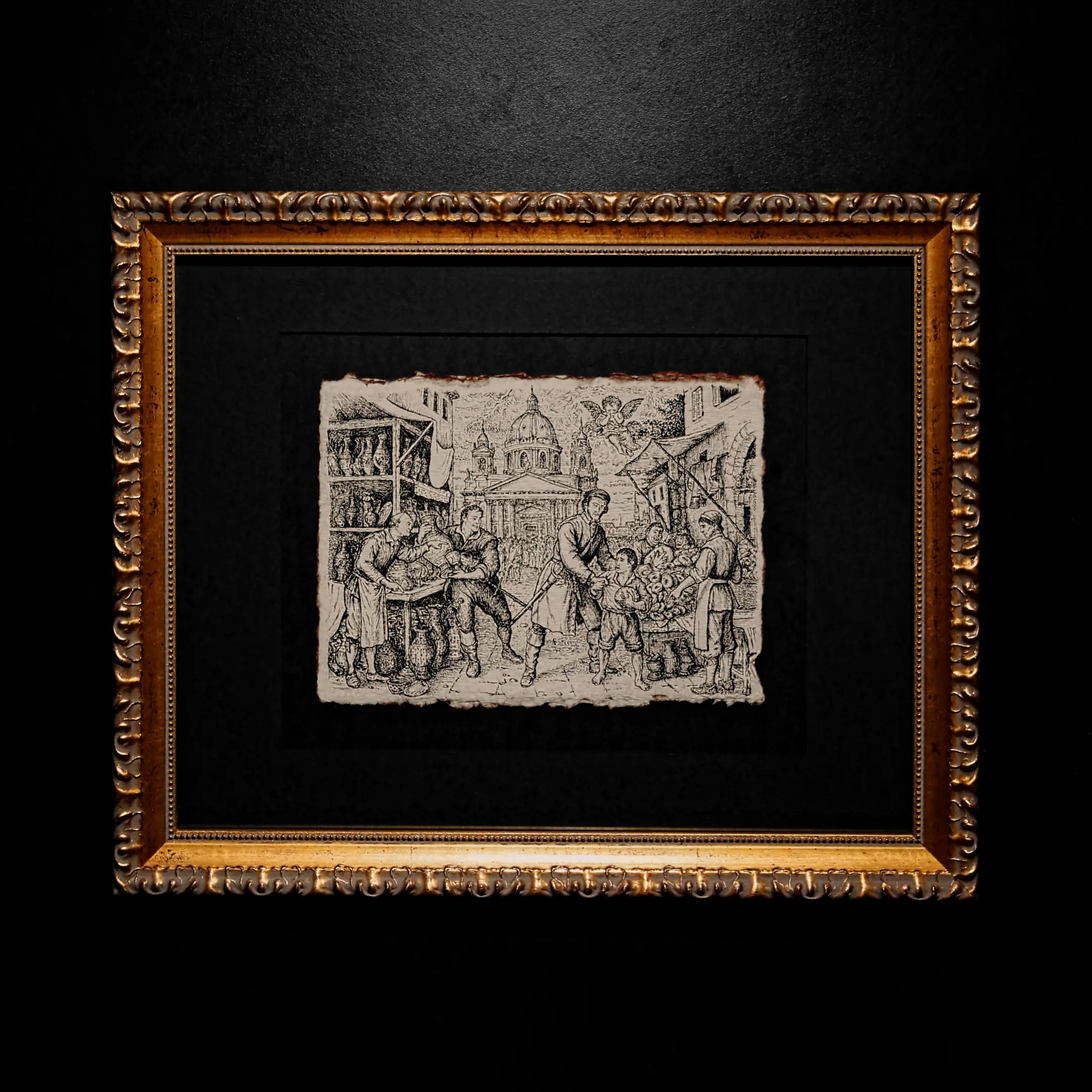
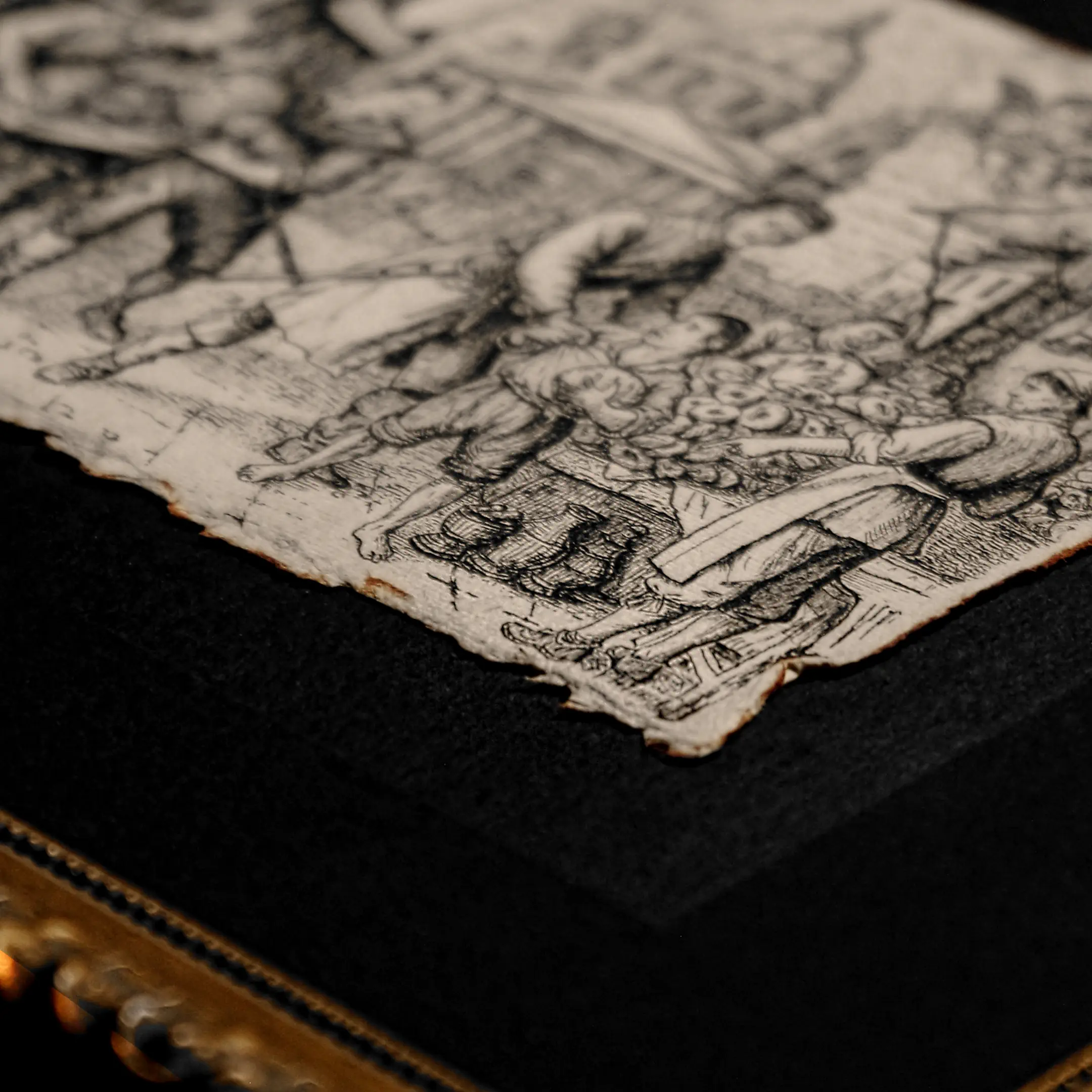
A remarkable tableau of narrative density, this unique work captures friction between chaotic commerce and sacred authority in a forgotten city. Crafted with traditional dip pen and iron gall ink on 300 gsm handmade paper, the composition offers exhaustive detail extending from vendor’s stall to the distant and enduring dome. Zero corrections were permitted in its creation. Every mark is an irreversible finalized decision that demands a patient and scrutinizing gaze. The piece is fully encased in a museum-grade archival frame with UV protection for a century of display. Includes a companion hand-penned manuscript and ‘Making of’ film.
Technical Profile
| Attributes | Value |
|---|---|
| Contents: |
• Original Ink Art Object · Professionally mounted on a museum-grade archival backing using traditional wheat starch and japanese paper hinges (reversible mounting) |
| Specifications: |
• Sketch Size: 5 x 9 in, 12.7 x 22.8 cm |
| Materials & Origin: |
• Paper: 300 gsm Handmade Paper |
| Style & Artistry: |
• Technique: Classic dip pen and ink sketching. |
| Longevity: |
• 100-Year Archival Display Guarantee (Under UV-protected conditions) |
HISTORY OF ART OBJECT
LUNEDI MATTINA
The bitterness of humanity in trifles

PART I: THE VEIL OF THE MUNDANE
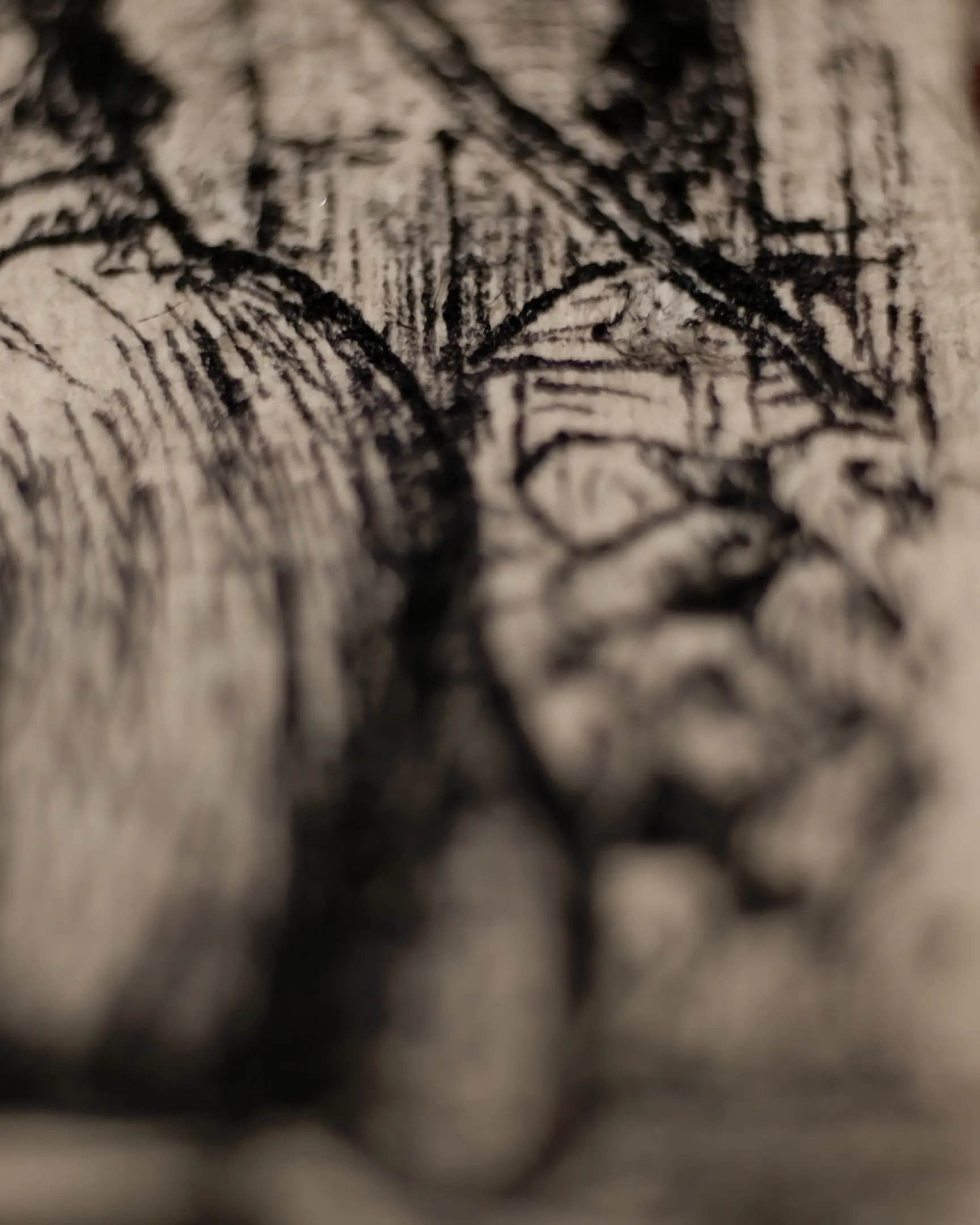
The dimensions of this work are 5 by 9 inches. It is executed as an ink drawing using an authentic 19th-century French dip pen on handcrafted paper. The medium employed is waterproof iron gall ink, prepared by hand in the United States according to a traditional 19th-century recipe.
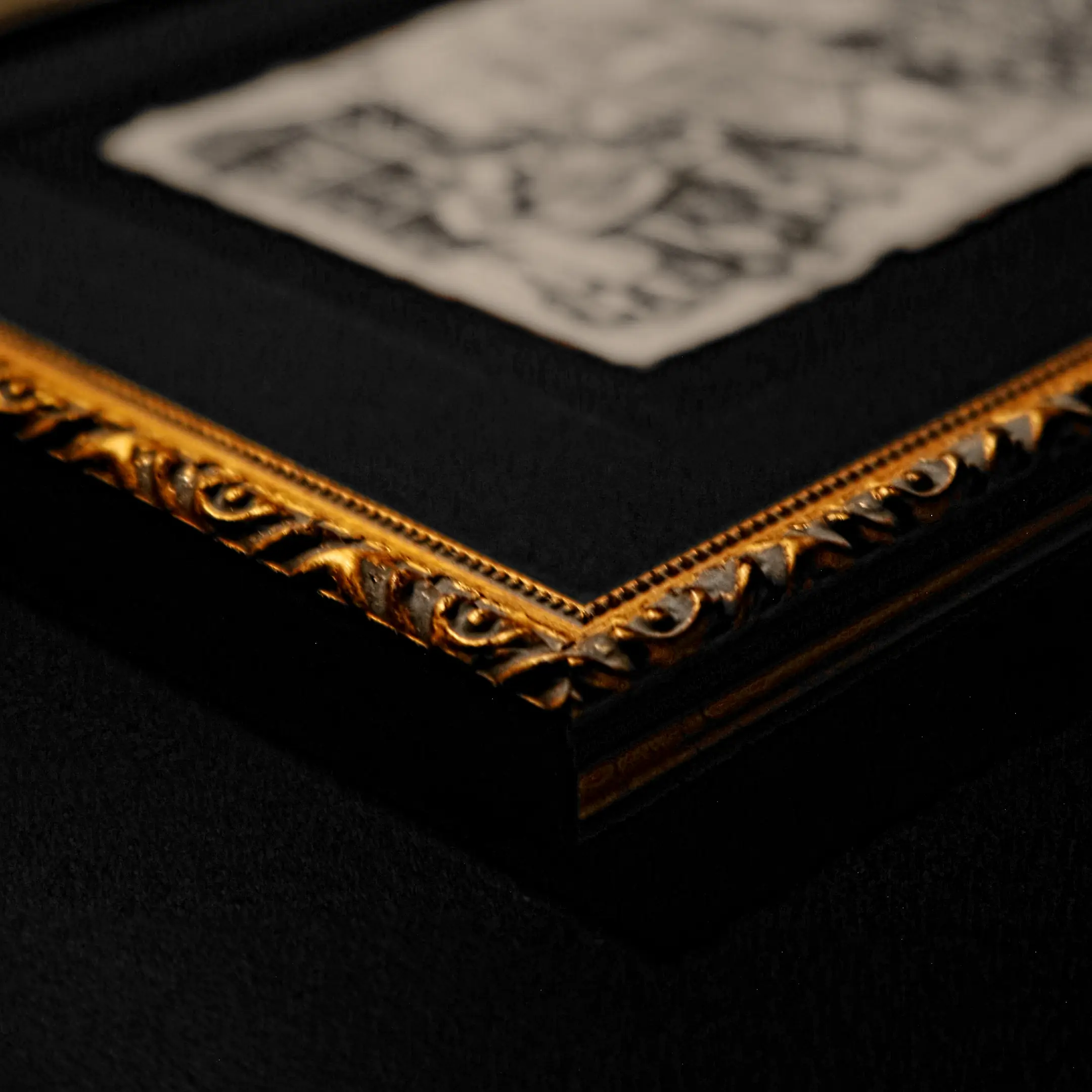
The artwork is mounted to its backing with rice paper and a starch-based adhesive in accordance with the highest museum archival standards. It is encased in a pH-neutral black passe-partout and protected by UV-filtering glass. The frame is a bespoke artist’s molding specially crafted in Estonia.
The piece is created in the distinctive style of “Libretto Neoclassicism”. Accompanying the painting is an official Certificate of Authenticity and a curated collection kit, the details of which may be reviewed in the technical profile.
The title of this work is LUNEDÌ MATTINA, which translates to Monday Morning. This title deliberately invokes a sense of the everyday, artfully lowering the viewer’s expectations from the very first encounter. It presents the scene as something commonplace, perhaps even inconsequential. Indeed, what of note could transpire on a Monday morning? It is merely the dawn of a workweek, prosaic and unremarkable.
Most observers will pass by, perceiving this work as nothing more than a fleeting sketch of 19th-century life. Yet, a profound revelation awaits those who care to draw back this curtain of the mundane, looking deeper into the composition and its meticulous details.
Today, you are invited to encounter one of the most multifaceted works by VSELÉNSKYI. Hidden beneath the surface are layers of meaning that demand reflection and discourse. It is a dialogue that promises to refine our collective understanding and, perhaps, move this world toward a more thoughtful existence.

PART II: THE NARRATIVE UNFOLDS
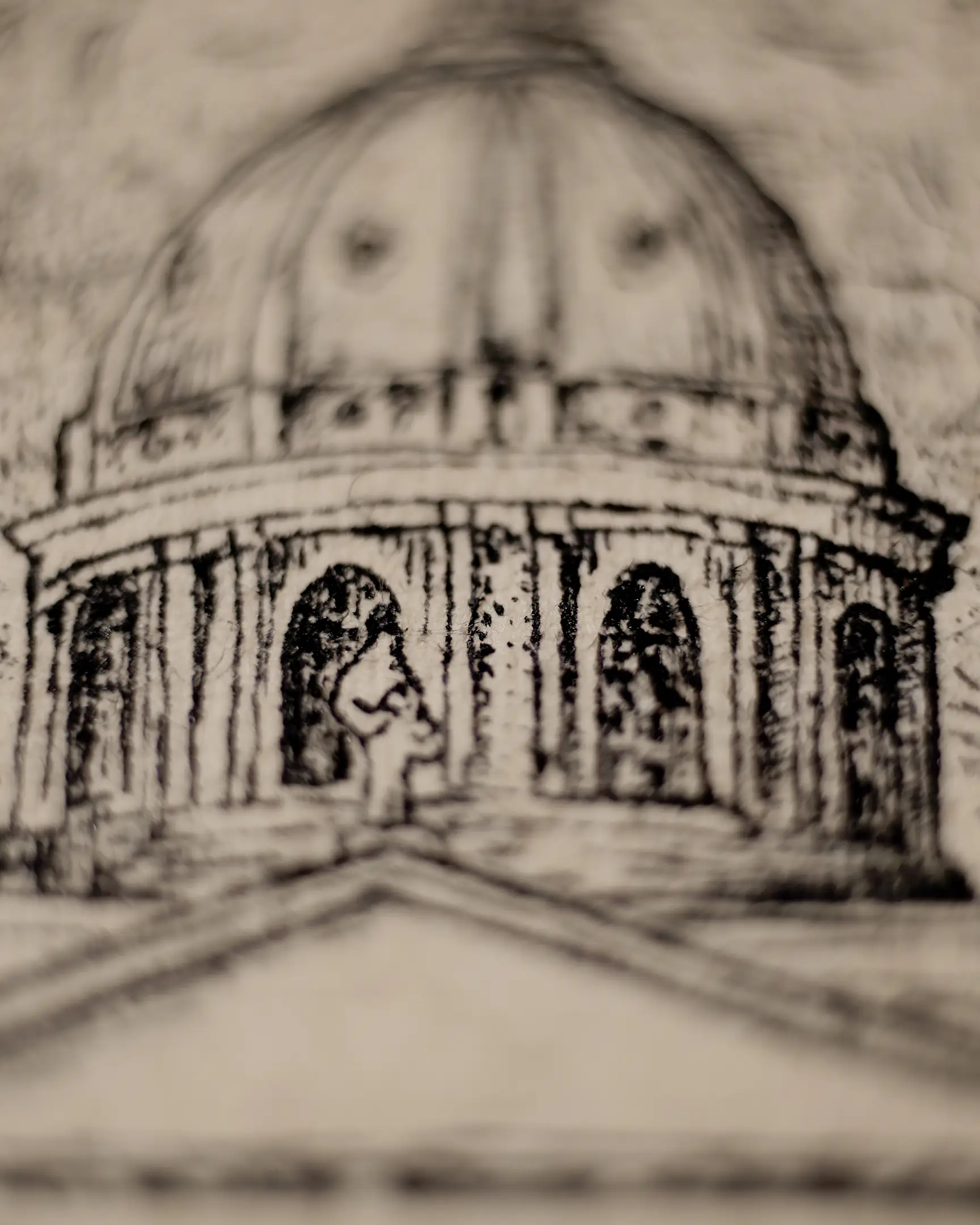
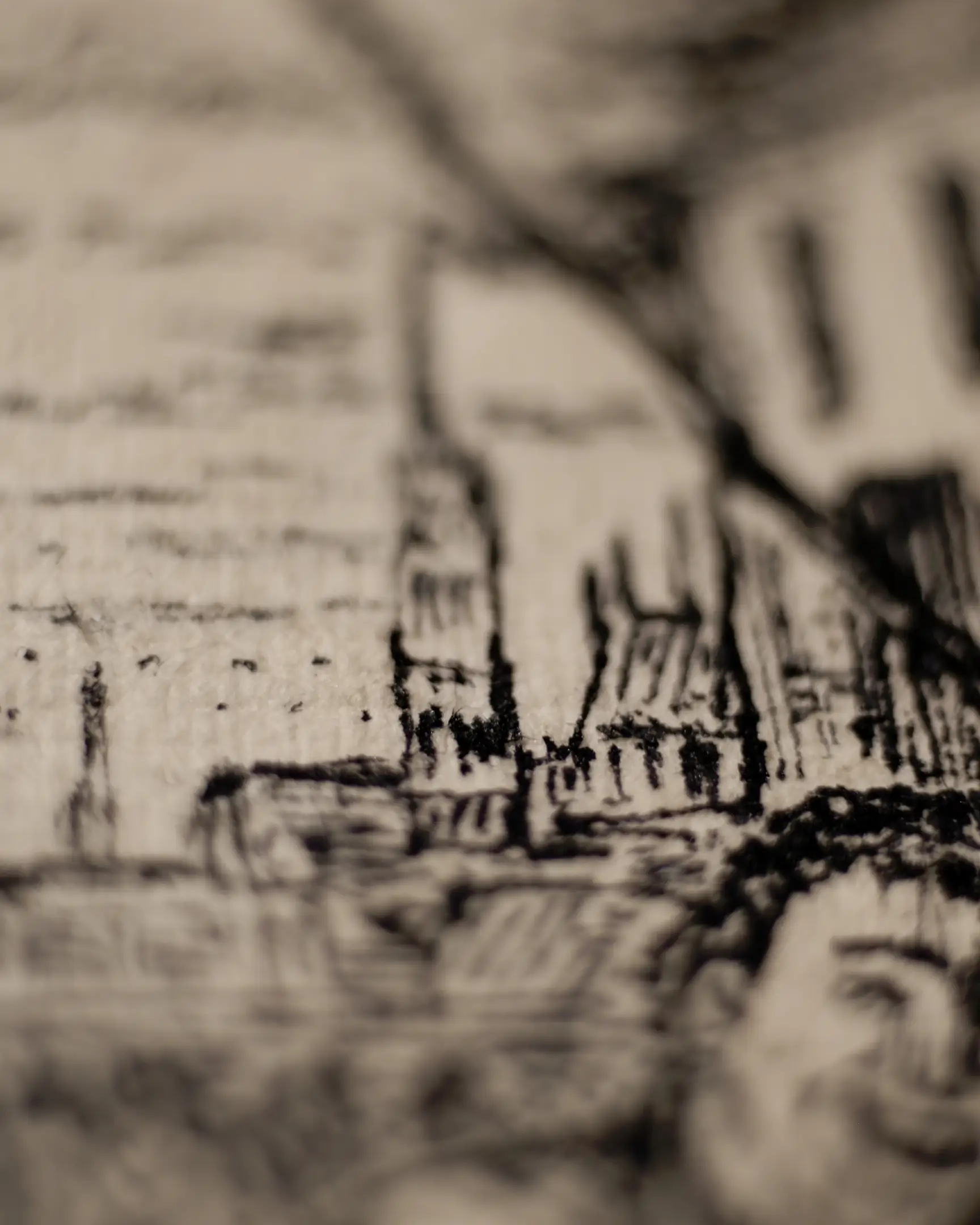
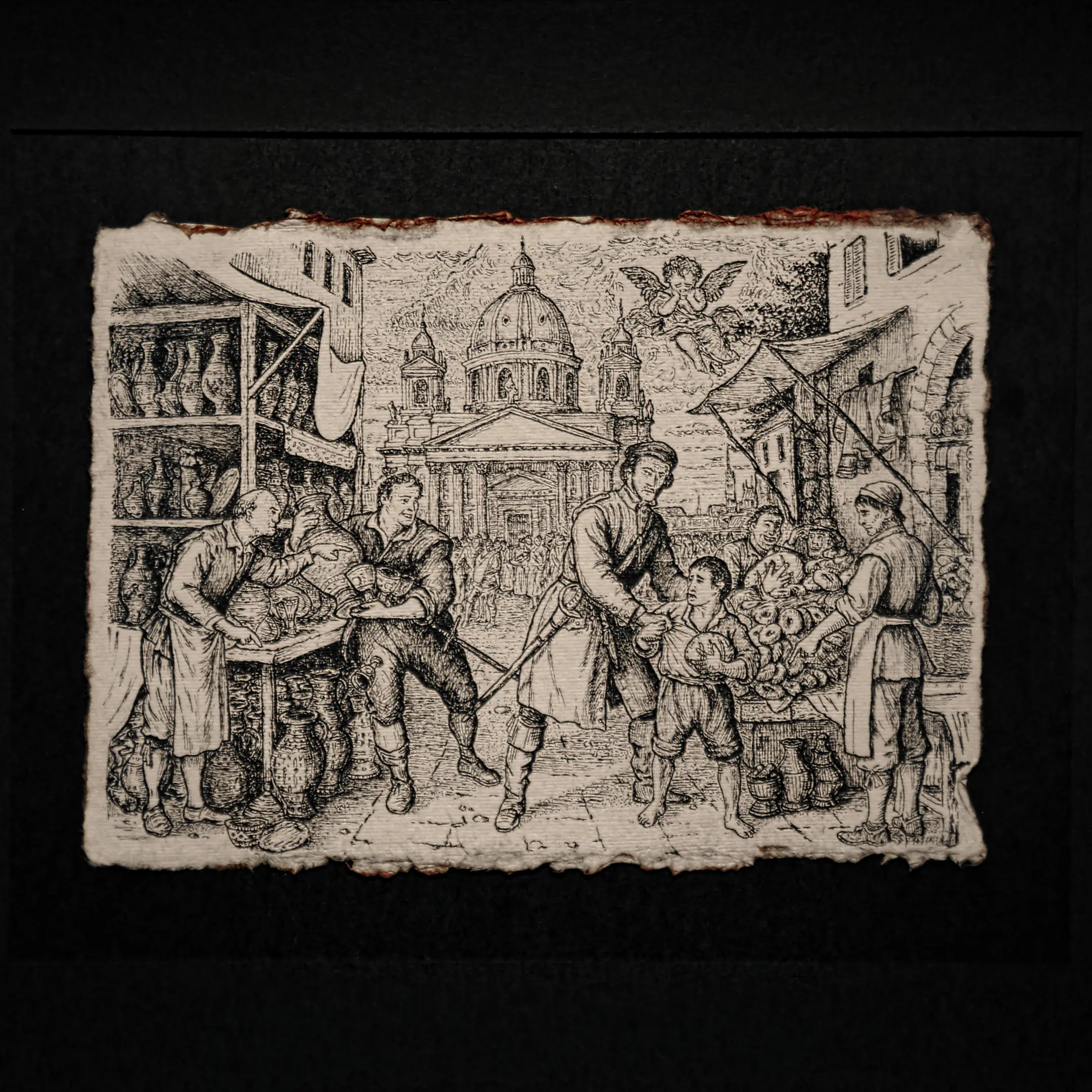
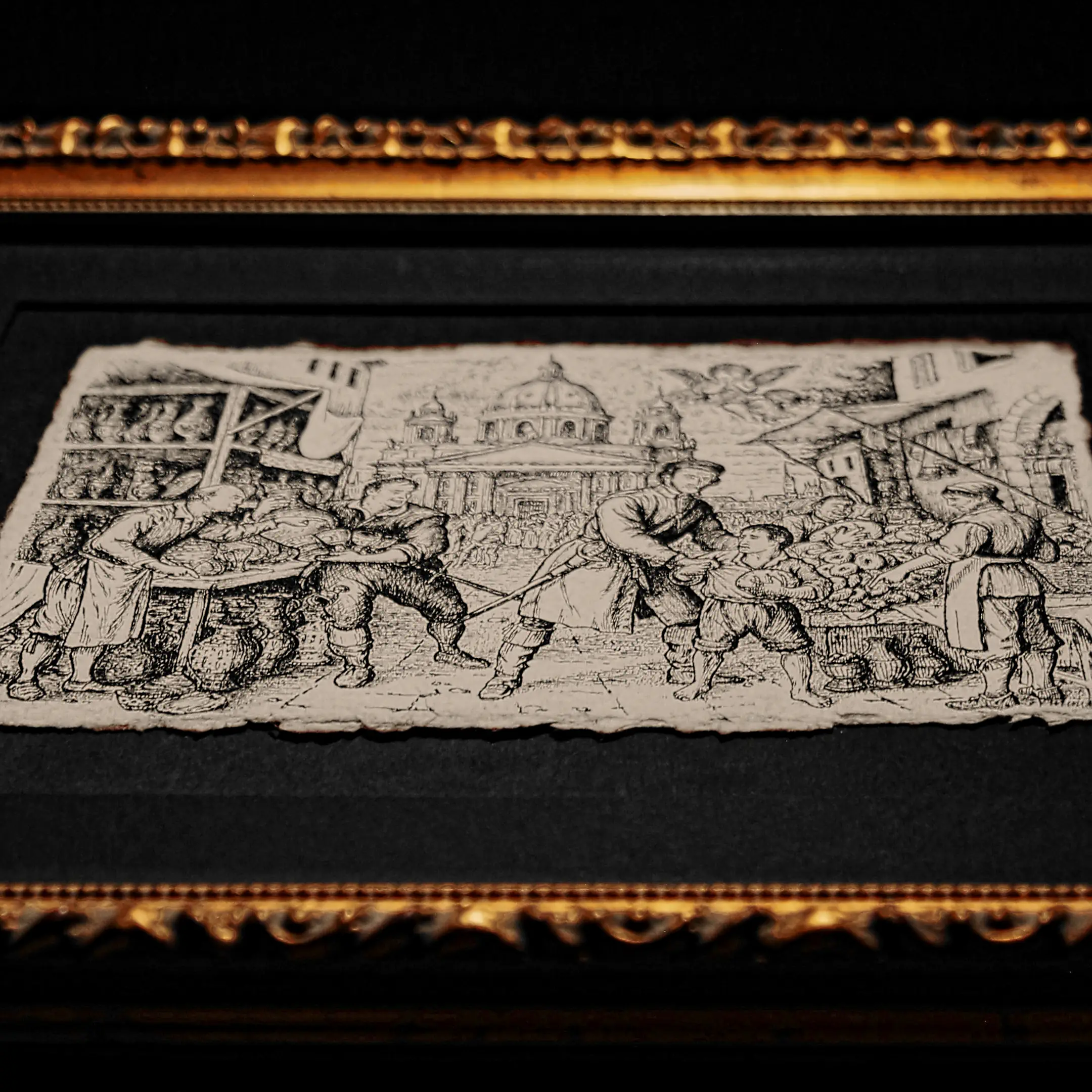
At the heart of the composition lies a vast market square of a 19th-century European city, set against the backdrop of a majestic cathedral. The square is a labyrinth of commerce with rows of stalls, arched passageways, and an abundance of wares. To the left, a counter displays an array of vases crafted in the antique manner. They rest upon the floor, beneath the trestles, and along the shelves, featuring vessels tall and broad, of varied forms and hues, adorned with intricate patterns.
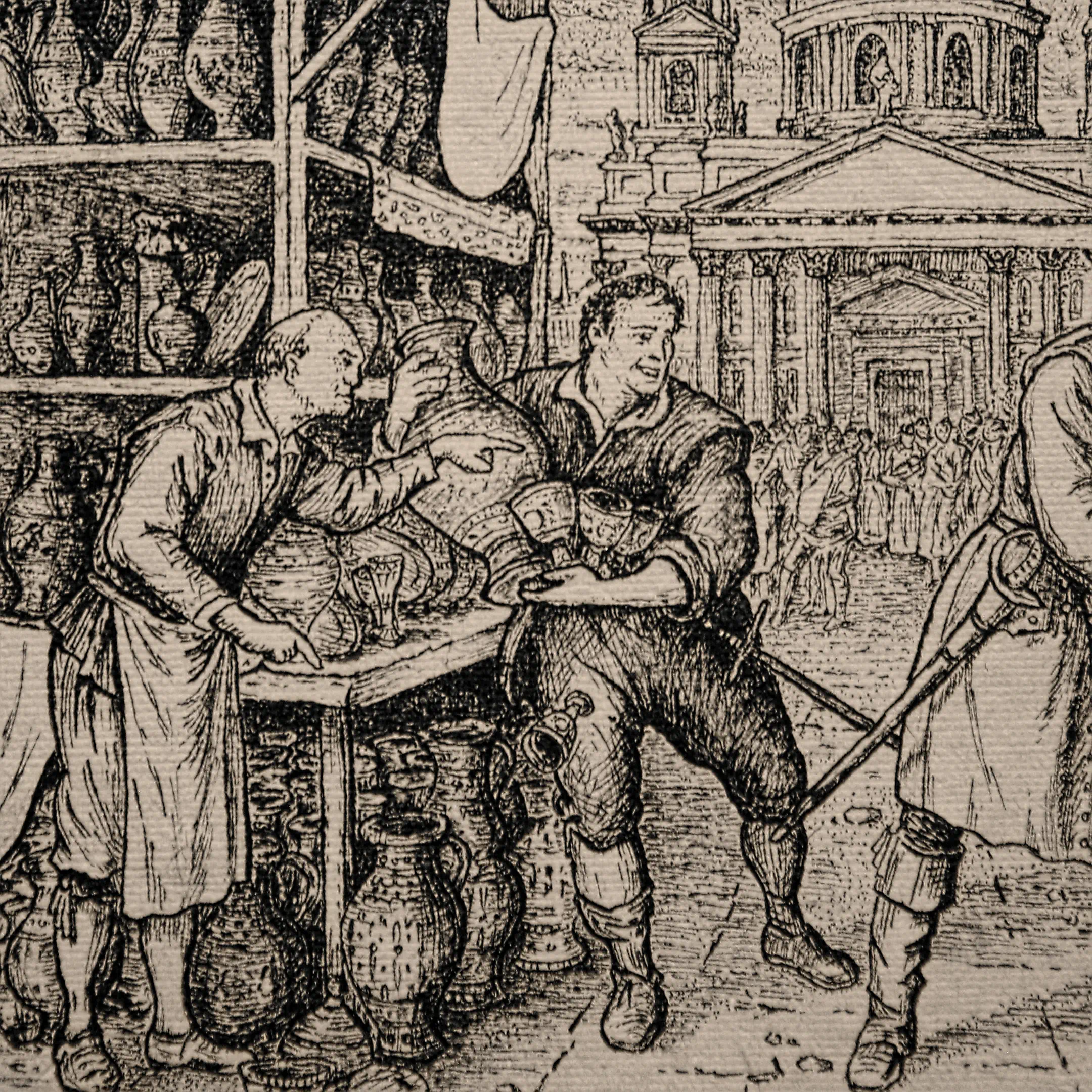
Upon their surfaces, one can discern silhouettes of horses and men, whispering silent tales of antiquity. Nearby, an elderly merchant stands as a quiet sentry over his collection of plates, saucers, and glassware.
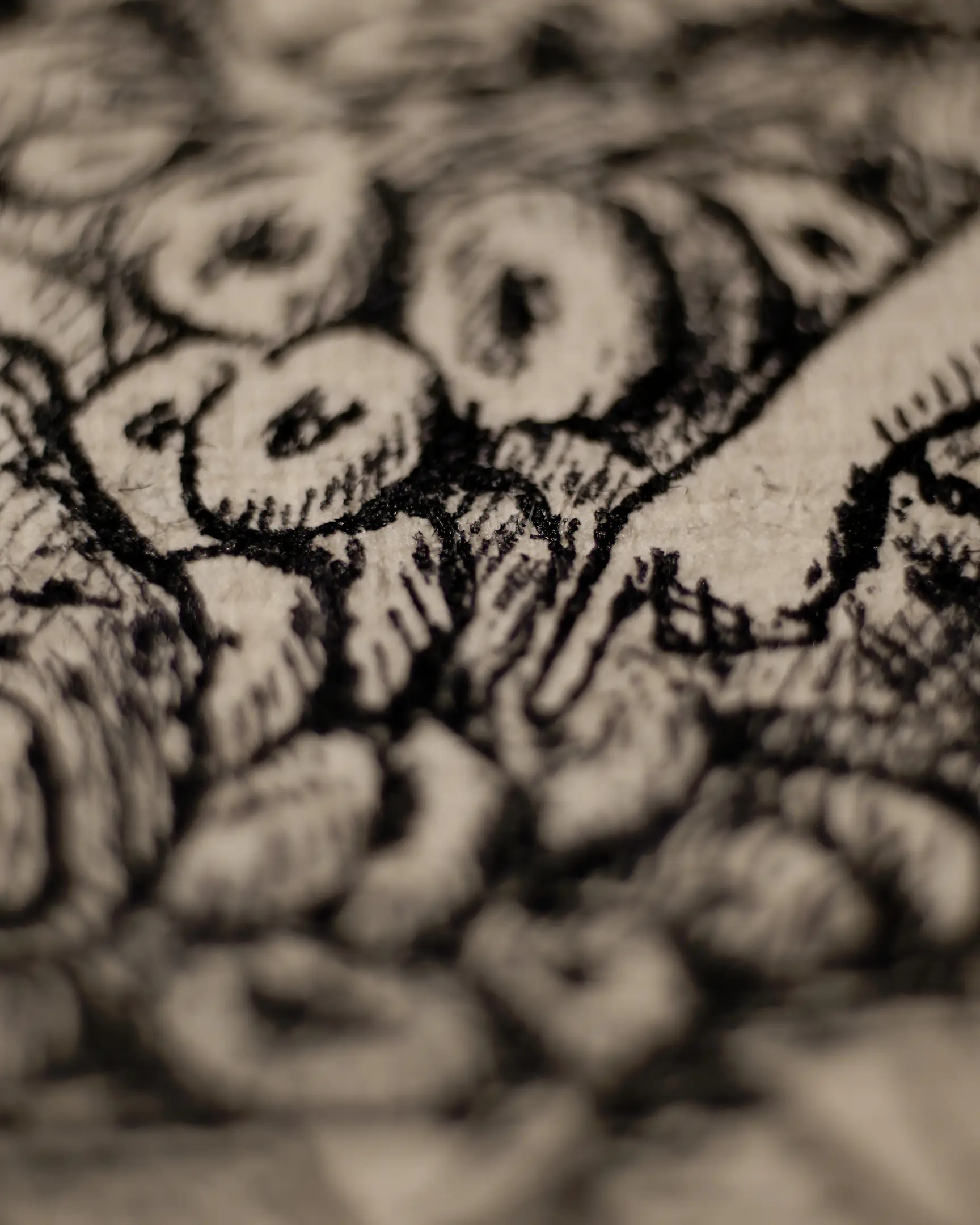
To the right, the atmosphere shifts to the sensory warmth of a bakery. A stall overflows with loaves of fresh bread, small circular rings, and dessert pastries. Beneath the counter, three vessels hold sweet confections, while further to the right, an archway reveals the glowing maw of the bakery itself. Here, the bread is not meticulously arranged but piled in a bountiful, chaotic heap. This serves as a testament to the frenetic pace of trade, where sustenance vanishes as quickly as it is hearth-baked. Beside this abundance stands the baker, clad in his apron.
At first glance, it is merely a common Monday morning. A city square. A bustling market. What could possibly disturb this equilibrium? And yet, as the eye wanders, one begins to sense a subtle commotion. We realize that something is amiss. Our gaze is inexorably drawn away from the quiet stalls and toward the epicenter of the canvas.
PART III: THE ASTERN THEMIS
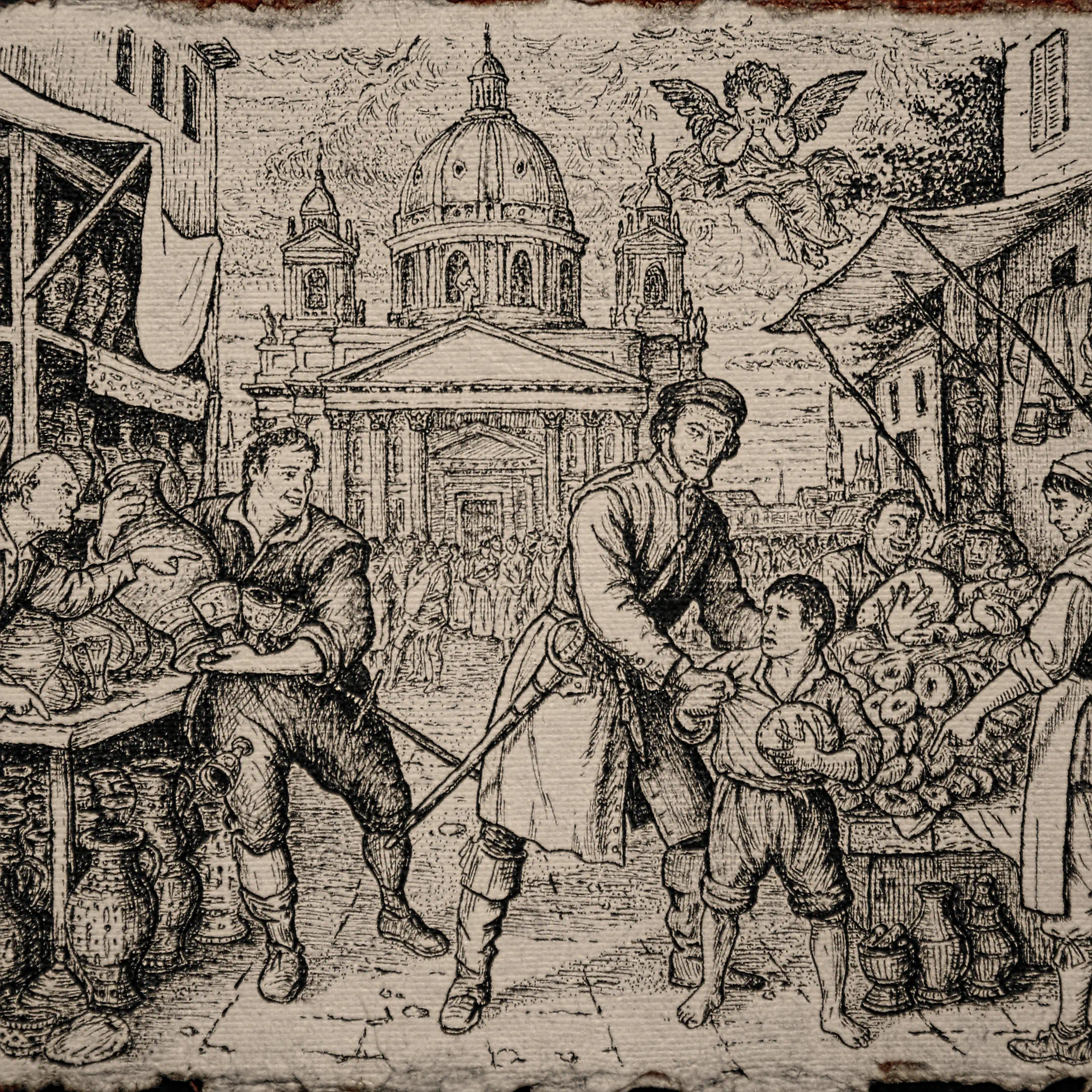
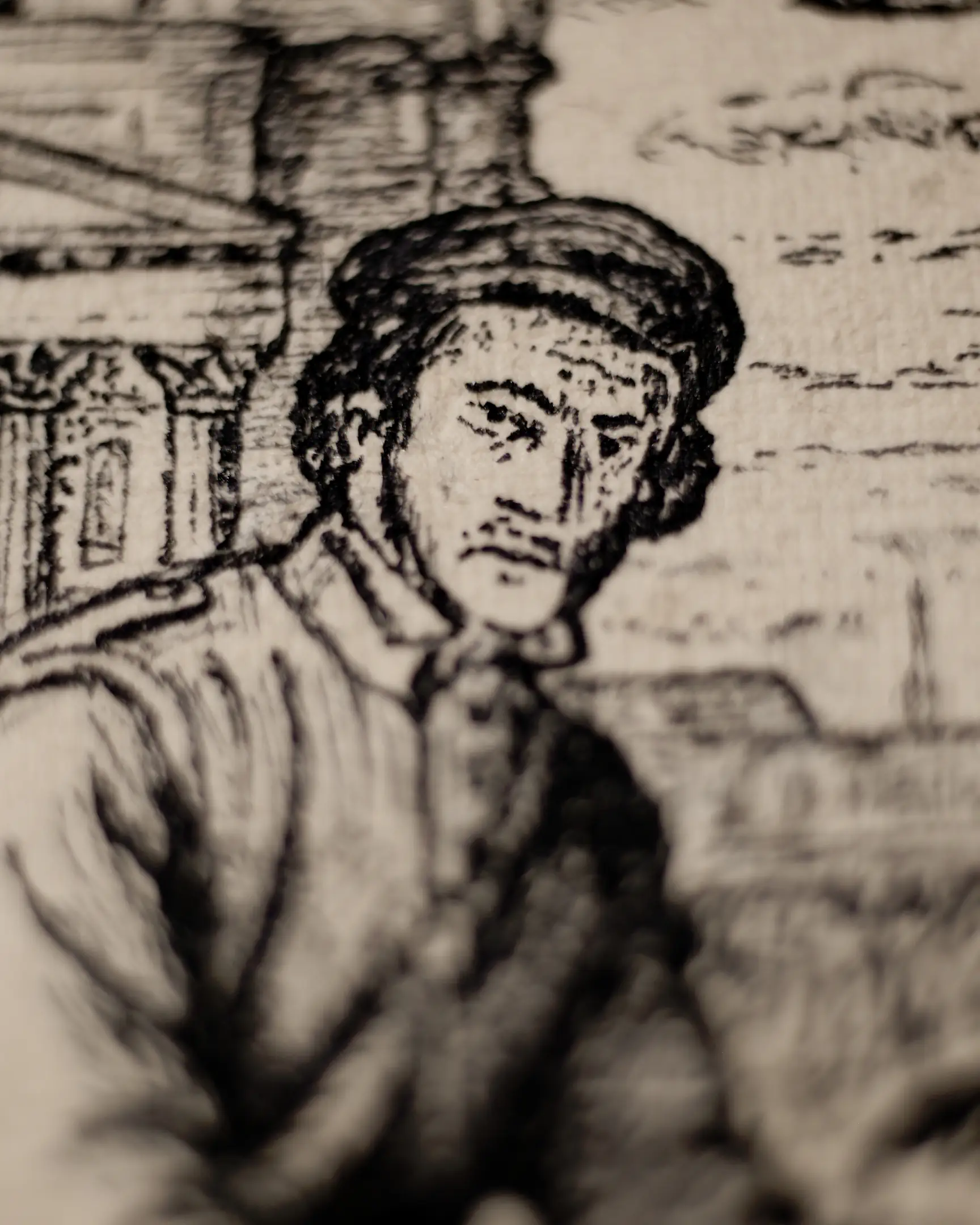
At the very center of the canvas stands a figure of imposing authority, a man clad in a long, austere tunic and a tightly fitted beret, his feet encased in heavy leather boots. He is armed with a saber which hangs from a scabbard fastened to a diagonal shoulder belt. His appearance immediately identifies him as a guardian of the peace. From his belt hang a dagger, a set of keys, and a pouch, while his collar, turned up in a rigid stance, and the row of meticulously fastened buttons signify a man bound by the unwavering discipline of his service.
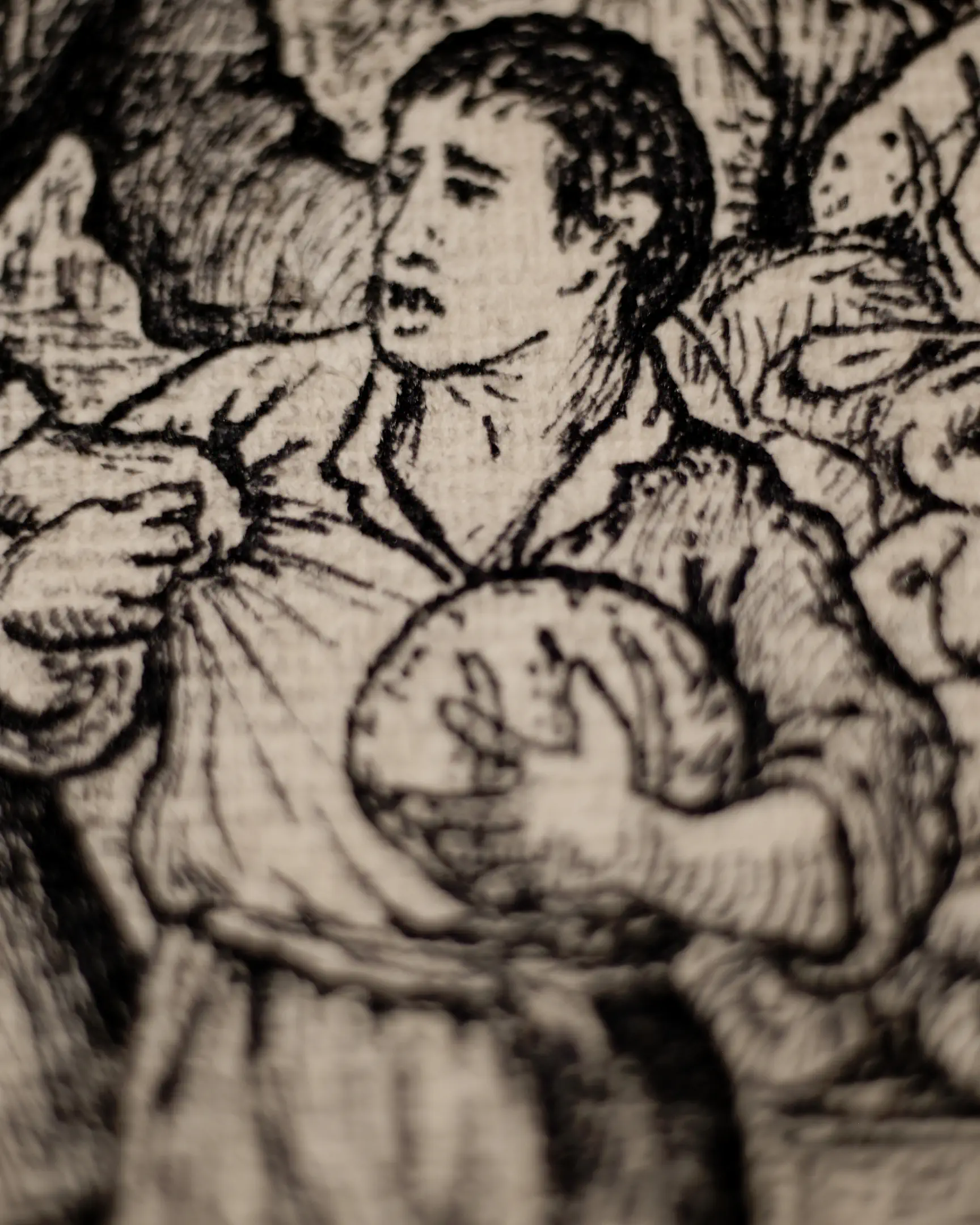
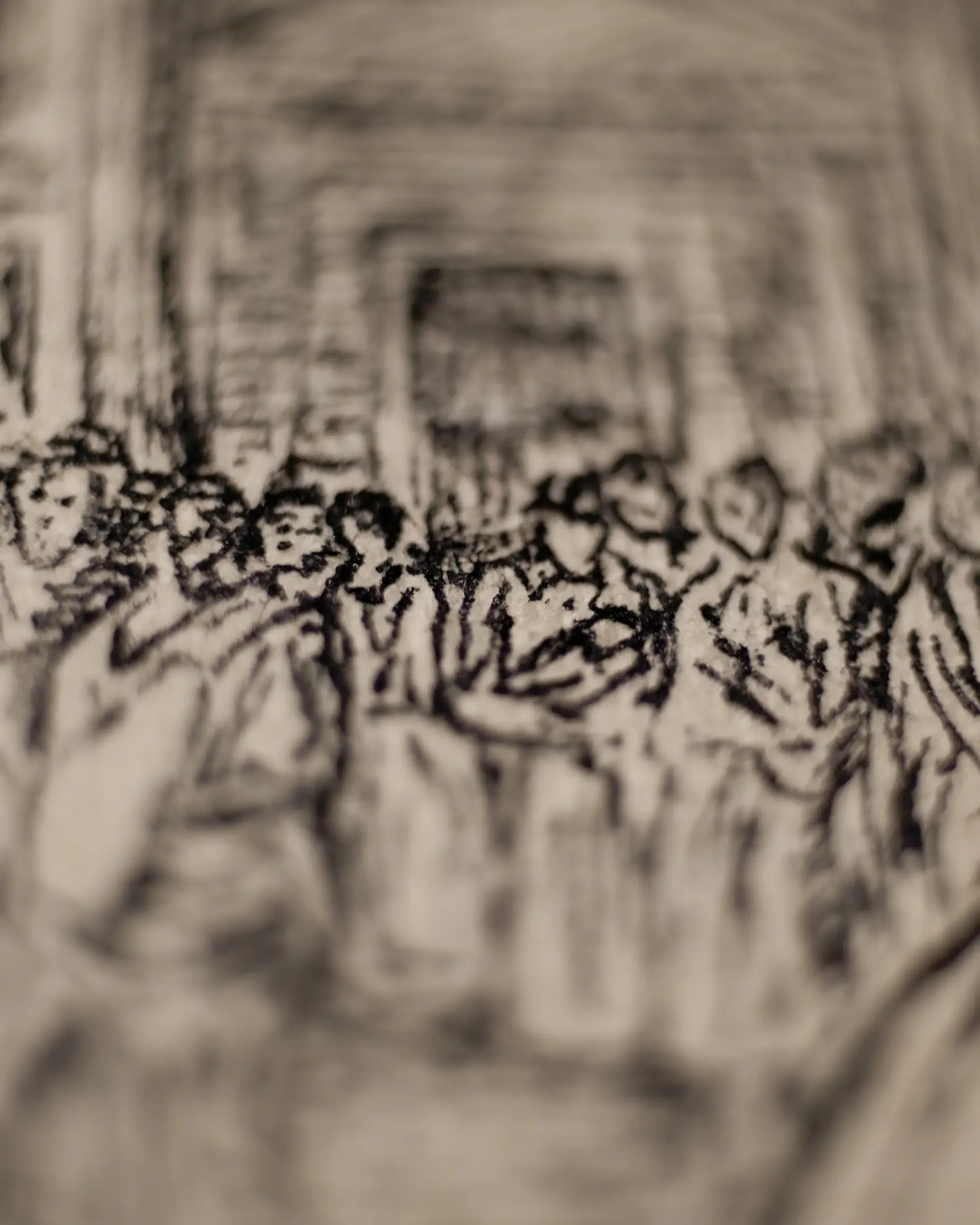
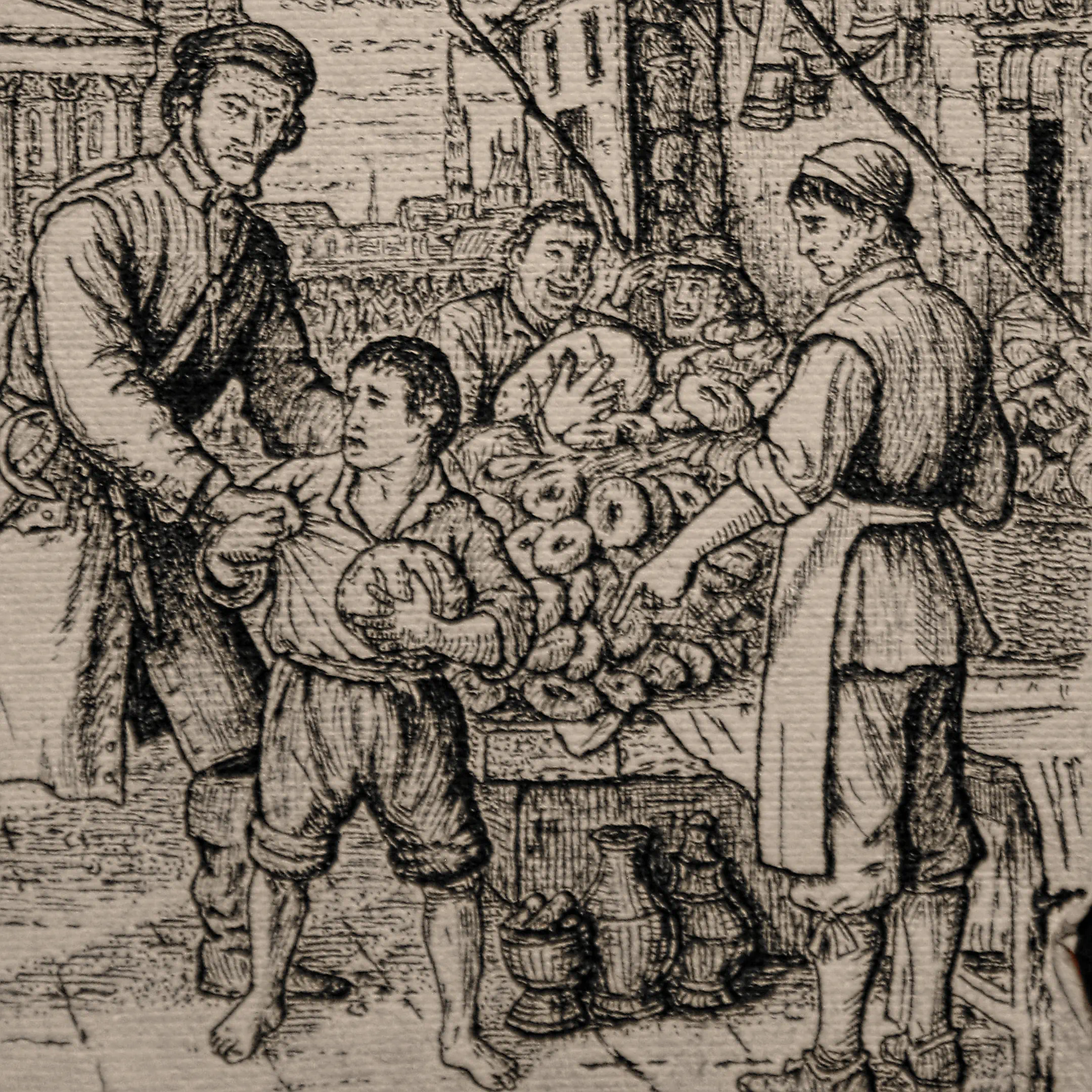
His gaze, however, betrays a flickering uncertainty as it meets our own. He remains frozen, as if awaiting a verdict from us, the spectators. It is then that our eyes descend to reveal the grim reality, as this officer of the law has seized a young boy, holding him with a coarse and unforgiving grip.
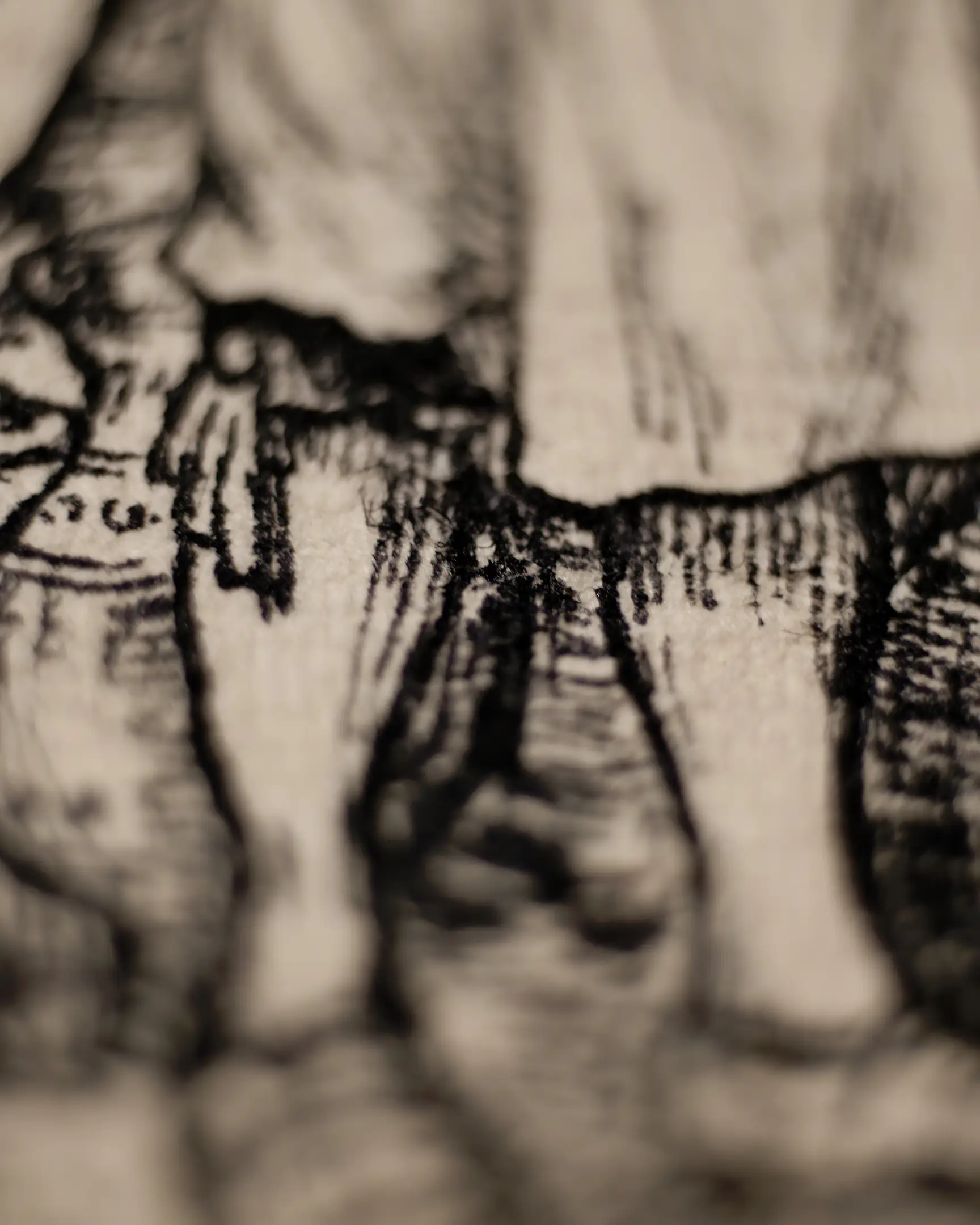
The child stands barefoot upon the stones, a mark of his destitution. He wears roughly cuffed trousers and a disheveled shirt, far too large for his slight frame, likely the tattered remains of a father’s or elder brother’s wardrobe. Clutched tightly against his chest in his left hand is a single loaf of bread. His face is a haunting portrait of terror and a silent plea for mercy.
Here, the primary, though perhaps not the ultimate narrative unfolds before us. A starving boy has stolen a loaf from the neighboring stall, only to be ensnared by the iron hand of the law.

PART IV: THE CLAMOR FOR JUSTICE
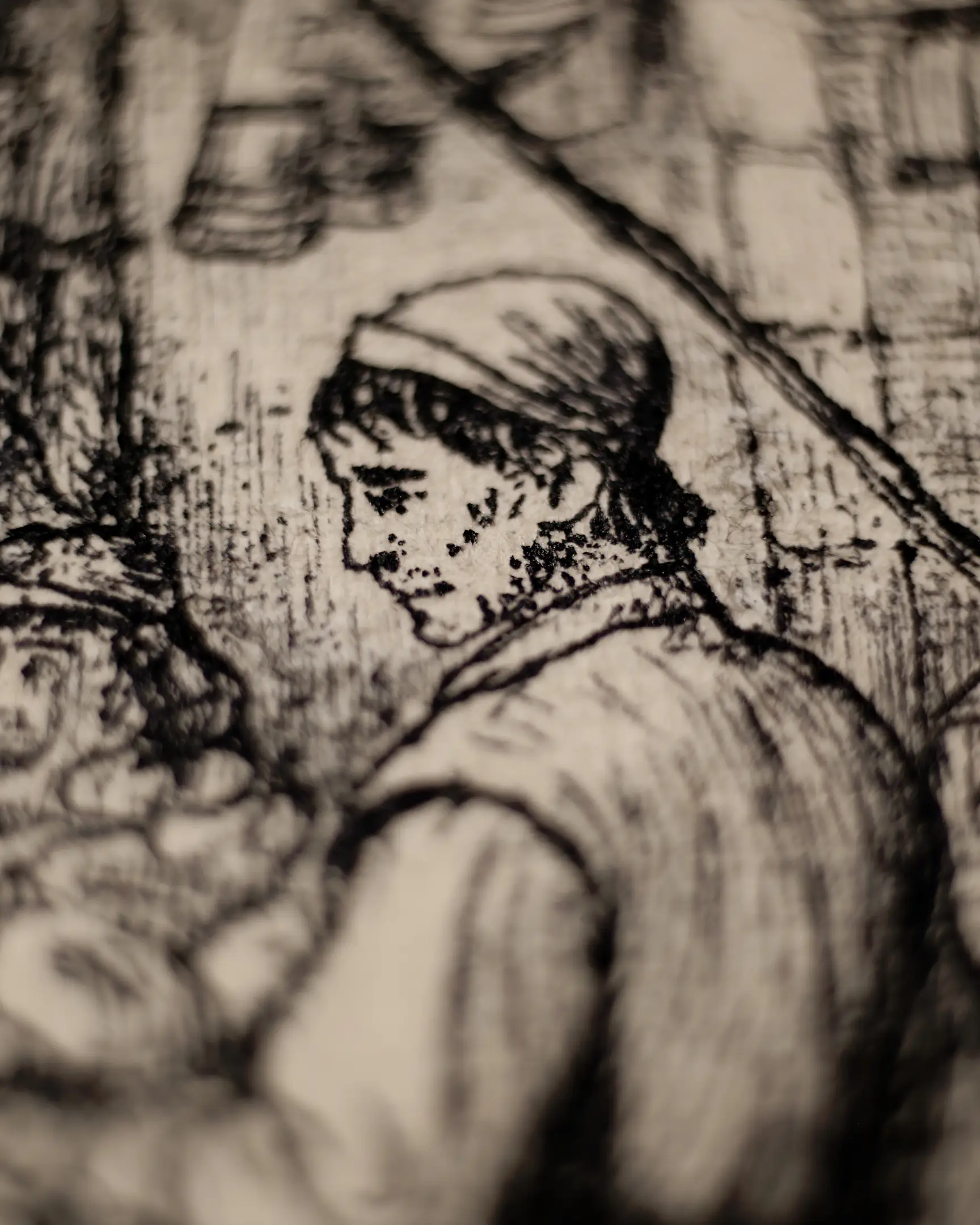
To the right of the boy stands the baker, marked by his pristine white apron, rolled sleeves, and head-cloth, the uniform of a man whose days are spent kneading dough and shaping loaves beneath the archway. His finger is extended in a sharp, accusing gesture, demanding that the small thief be apprehended and punished. His countenance remains unsettlingly calm; as he calculates his monthly earnings, he surely perceives each theft as a personal loss. In capturing this seemingly insignificant culprit, he seeks his due recompense.
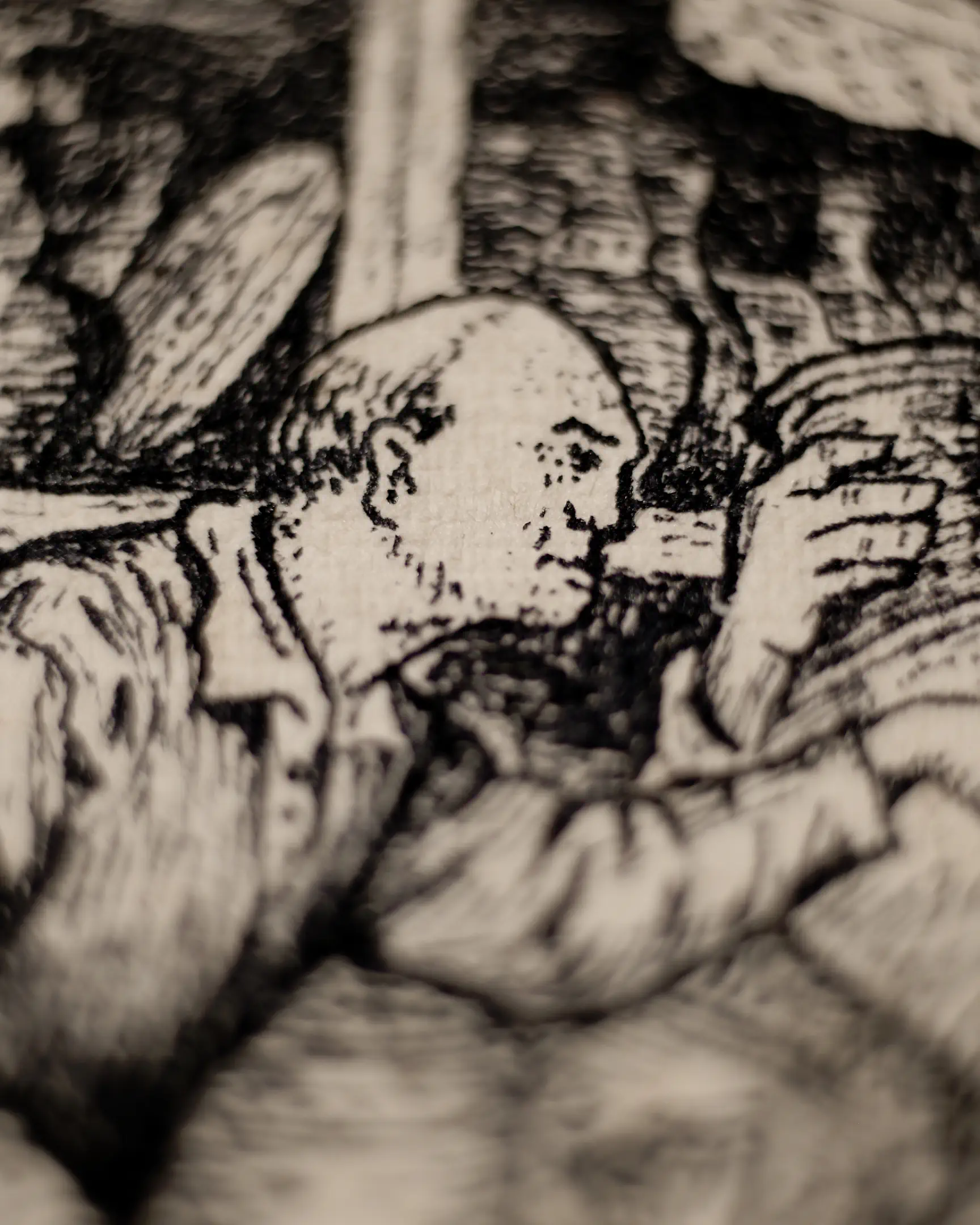
Torn by despair, the boy casts his gaze about the square in search of a savior, eventually turning toward the vase merchant on the left. Is it not in the wisdom of age that we seek refuge? Who, if not a sage elder, could explain to the officer that the primal pangs of hunger are not a deed deserving of such cold retribution?
The aged merchant, clad in his weathered apron, craftsman’s boots, and worn waistcoat, bears the marks of a lifetime dedicated to his trade. One might assume that after so many years, he would offer a hand of mercy. After all, what is the value of a single loaf? Even a hundred such loaves cannot weigh against the price of a single exquisite vase.
But does the barefoot boy find the support he so desperately seeks? Let us look closer at the old man on the left.
The answer is a chilling “No.” The merchant, too, points his finger at the child, his face twisted with the characteristic grumpiness of the aged, demanding punishment as if this boy were the sole architect of all his misfortunes.
Here, the second intellectual layer of the work is unveiled, revealing the universal desire for “justice.” Every witness demands that the child who stole the bread be punished to the full extent of the law. Can we truly condemn them? Commerce is a grueling labor, and if one thief is pardoned today, even a small boy, a hundred more may follow tomorrow. This is a question each spectator must answer for themselves. Yet, are there perhaps details hidden within the canvas that might sway your verdict?
PART V: THE SILENT SUBTERFUGE
As our gaze follows the merchant’s accusing finger, a new layer of meaning emerges, one that irrevocably alters our perception of the entire scene.
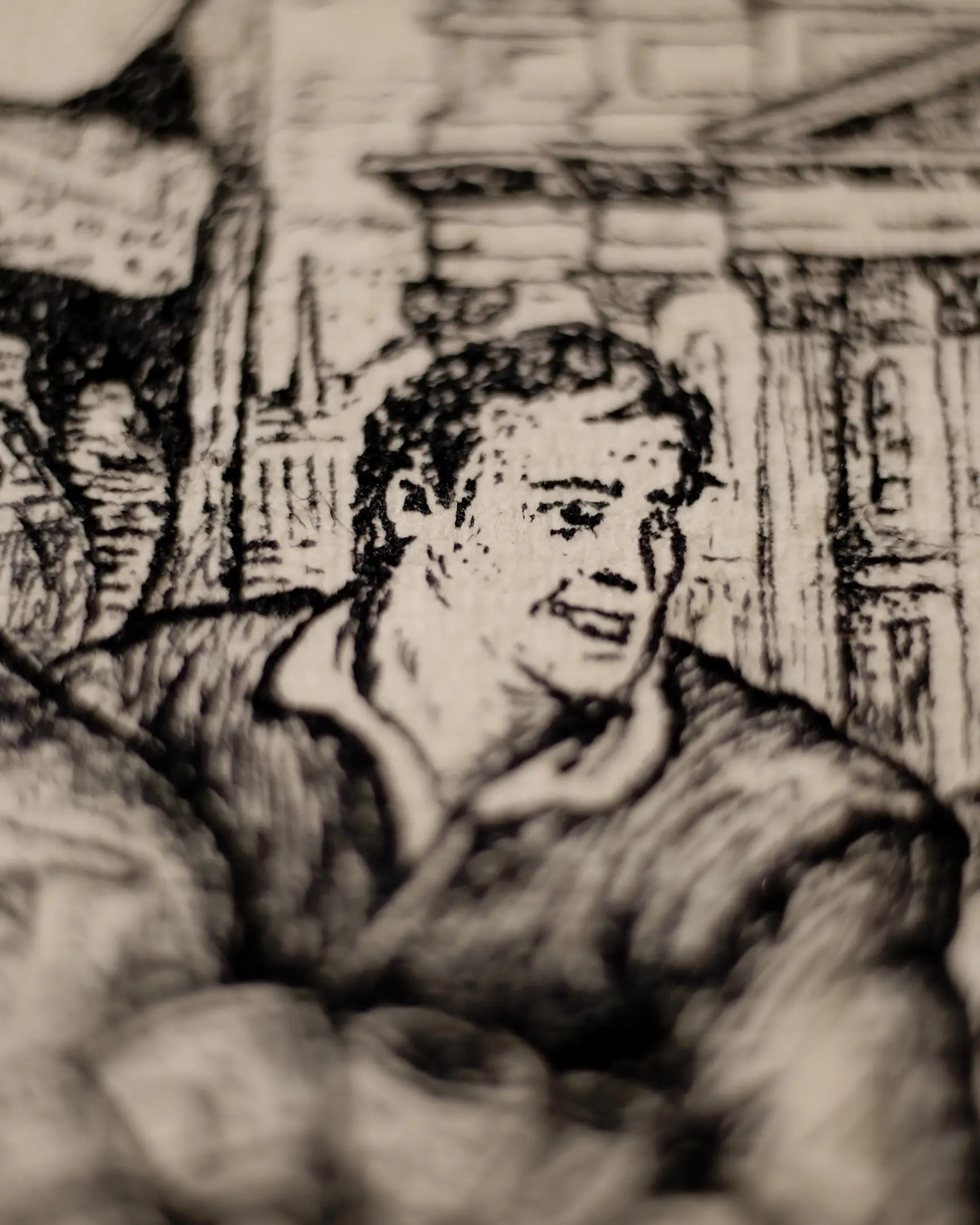
Standing beside the vase merchant is a man whose status is hinted at by the saber hanging from his belt. He is neither peasant nor tradesman, but perhaps a Garibaldino or a member of the coastal port guard. In his arms, he clutches a massive vase and three goblets. His eyes are fixed upon the boy, his face twisted into a smirk, even a sneer. To him, this spectacle is mere amusement. He does not demand punishment, nor does he cry for justice, as his hands are occupied with his prize.
Then, we notice a falling glass, and the harrowing truth is revealed: this man, carelessly balancing a hoard of finery, is nothing less than a looter. He plunders the stall while the elderly merchant’s attention is consumed by the child and his loaf. He steals without concealment, mocking the very idea of order. To him, this is but a mundane opportunity.
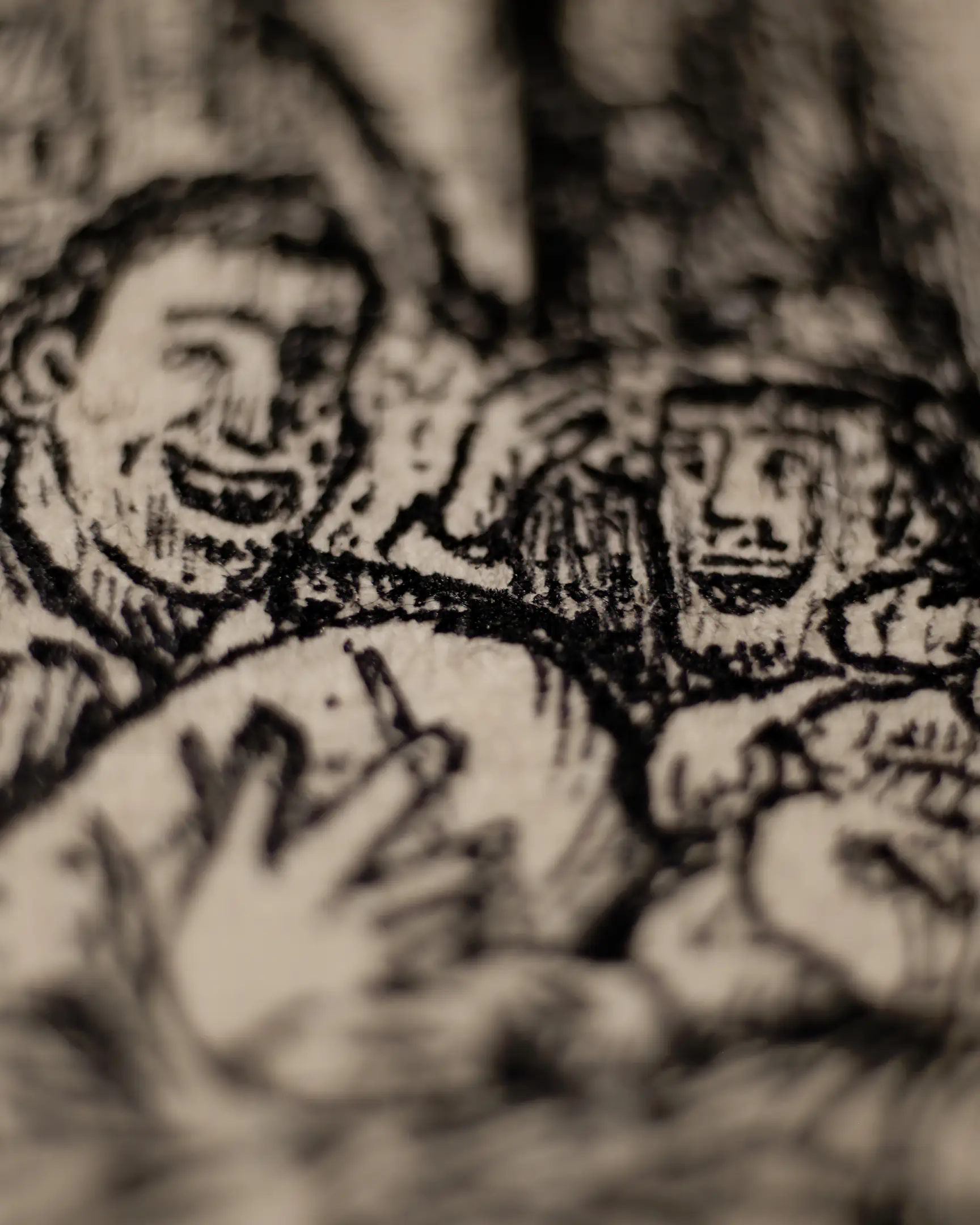
Our focus then shifts back toward the bakery, where we discern two figures lurking behind the counter. One, laughing, presses a large loaf to his chest, while the other clutches his hat in mirth. They, too, are entertained by the scene, and we realize they are two more thieves stripping the bakery bare while the baker is preoccupied with his clamor for “justice”.
The two merchants, positioned like pillars on the left and right, are entirely absorbed in their righteous indignation. It is unknown who first spotted the barefoot culprit, but both are now drowned in the pursuit of a minor transgression. Meanwhile, their livelihoods are being dismantled by predators upon whom no one deigns to look.
PART VI: THE SUPREME TRIBUNAL
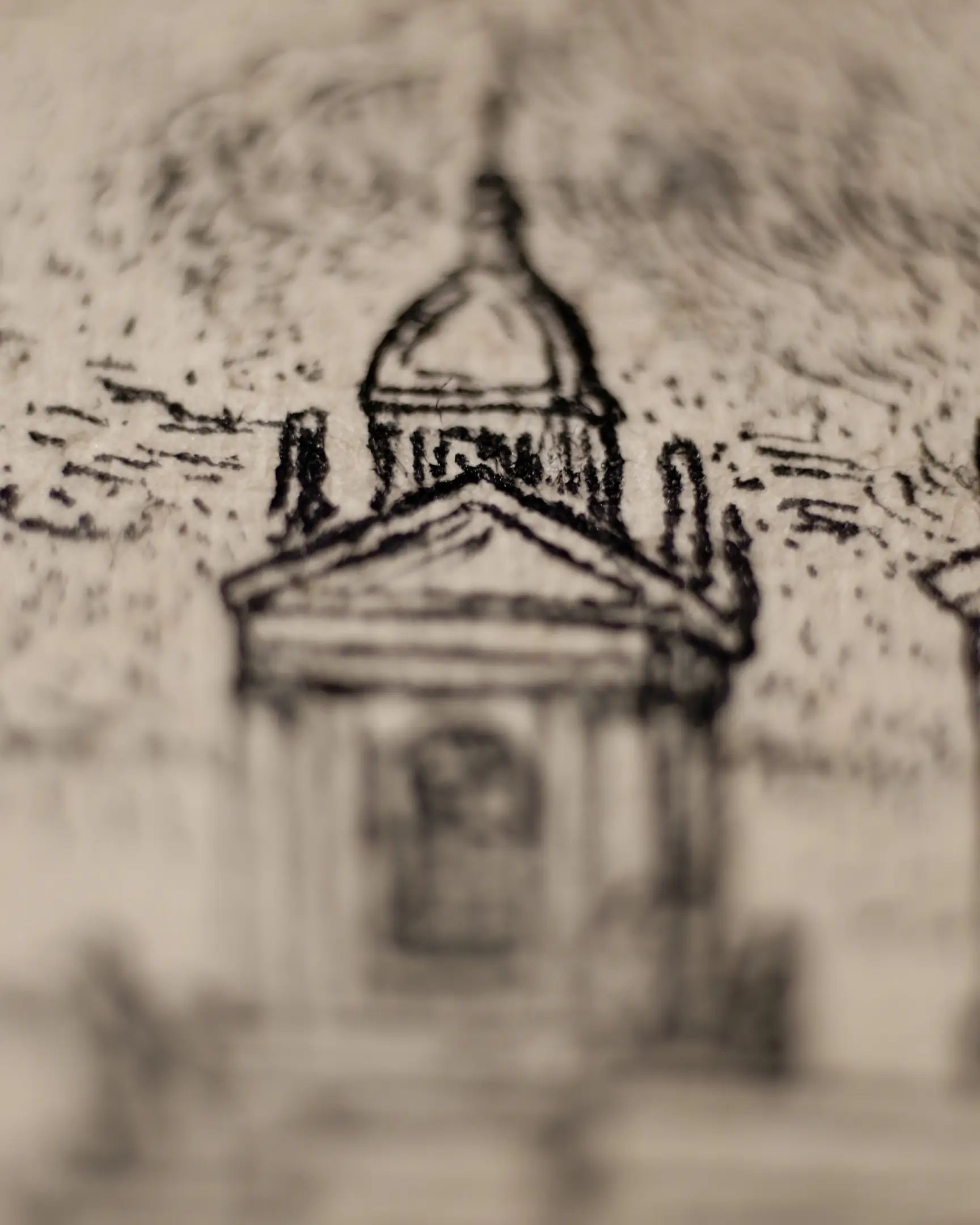
Finally, our gaze recedes into the depths of the canvas, toward the distant throngs of the market square. Some faces are turned toward the boy, while others remain absorbed in their own affairs; yet, notably, not a single soul notices the man plundering the vases, nor the two thieves absconding with the bread. For the crowd, the spectacle lies in the unfolding drama of the law: they watch with bated breath to see how the officer will act. Is this not, after all, the ultimate entertainment for the masses? As we look upward, the scene is framed by the formidable silhouette of a Classical temple, adorned with columns, pediments, and statues. It is a structure that embodies the indomitable nature of a higher power, its might, its permanence, and its transcendence. Such edifices captivate the human spirit regardless of creed.
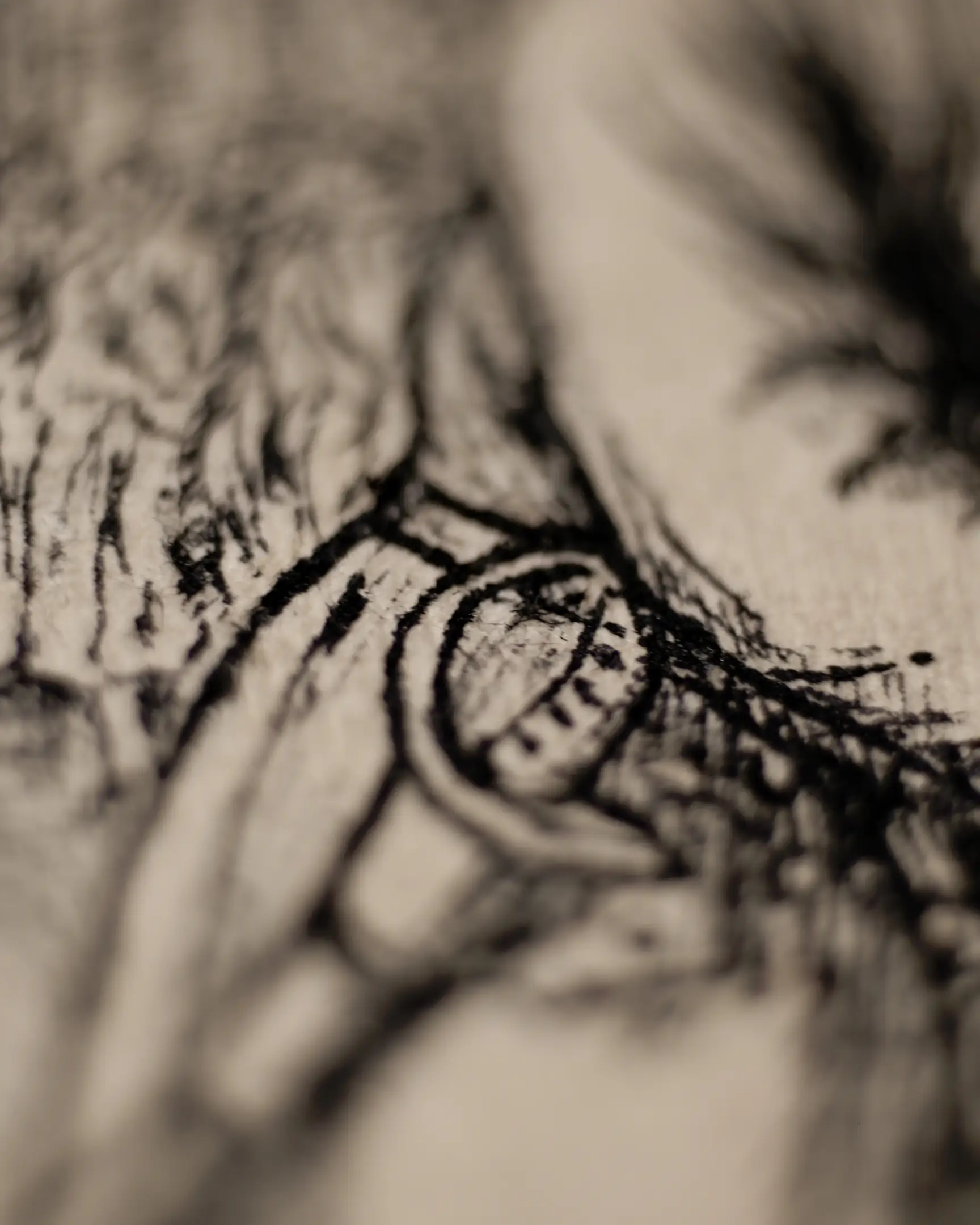
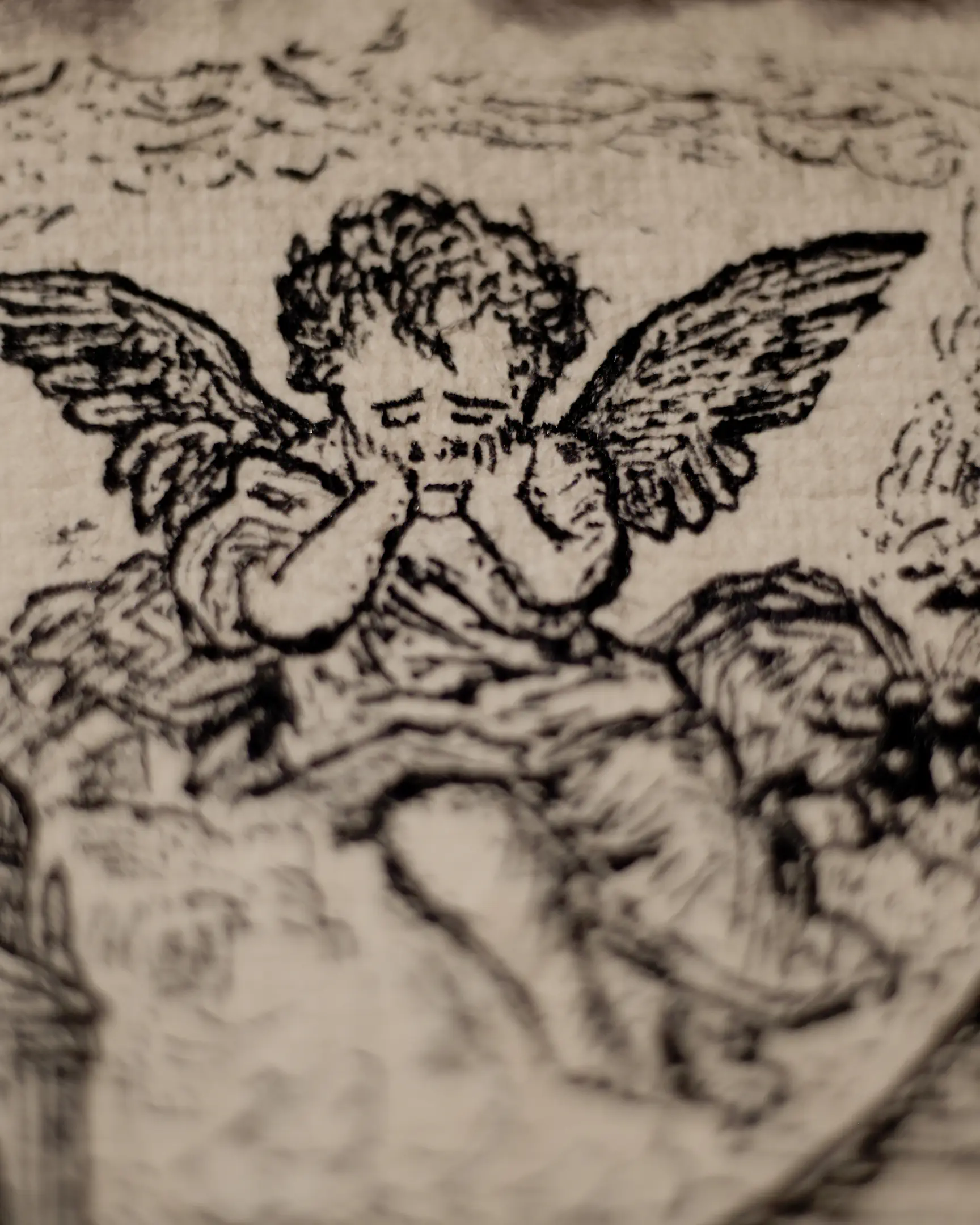
This monumental sanctuary towers not merely over the square, but over humanity itself. Involuntarily, our eyes climb the columns to the towers above, where we find an angel suspended in the heavens to the right. He holds his hands to his face, eyes closed in sorrow as he bears witness to this harrowing tableau. Can the church, the sages, the clergy, or the Divine truly sanction the punishment of a child for the simple, desperate urge to eat? Or perhaps, in their silence, they do?
As we step back from the canvas, one final detail remains: the piercing gaze of the officer. He looks directly at you, the spectator, posing a single, silent question: “What is to be done with him?”
In that lingering pause, as we withdraw further, the title returns to us: “MONDAY MORNING.” Here, the final layer of meaning is unveiled. This is the mundane. This is the everyday. This is the devastating “normalcy” of our world. For whatever happens next depends neither on the angel, nor the law, nor the officer… It depends entirely upon the spectator…

THE GENESIS OF THE MASTERPIECE
This work was executed by Vselenskyi using the traditional dip pen method. Specifically, it was rendered with an authentic 19th-century French nib on handcrafted paper. Furthermore, this piece was created as a definitive drawing without any preliminary sketches. The creation of this work spanned several months and reached its completion during a journey to Niagara Falls. This process was fueled by a series of contemporary events that deeply moved the artist.
The first of these catalysts was a public appeal from a major corporation. In this appeal, the company urged citizens to identify a woman who had taken an item worth less than $20 from a vast department store. Consequently, her image was broadcast widely to call upon residents of neighboring towns to aid in her apprehension.
This action struck the artist as profoundly disproportionate. In fact, the issue was not the size of the shop, but rather that a multi-million dollar enterprise was obsessing over a sum no greater than the cost of a few discarded tomatoes on a warehouse floor.
While countless people go missing and true criminals remain at large, the collective attention of a city was weaponized against a woman. Ultimately, she was driven to steal only a meager portion of food.
The second event was even more harrowing. A report emerged from another nation where a young man was detained by security guards of a multinational retail giant. This detention occurred over a suspected discrepancy involving a spice packet worth mere dollars. As a result, he was tackled and pinned to the ground. While they awaited the arrival of law enforcement, the guards remained atop him for so long that the young man perished from asphyxiation. Thus, he lost his life over the mere suspicion of stealing seasoning worth only a few dollars.
Vselsnkyi does not offer a moral verdict. Moreover, he does not seek to lecture. Instead, he simply presents the reality of our condition. This leaves every individual to find their own answer. Therefore, each viewer must meet the gaze of the officer and decide for themselves: “What is to be done with the boy?”
This work is complete and exists as a unique, one-of-a-kind original. A Genuine VSELÉNSKYI.
GALLERY